MIDI vs. Digital Audio: Two Parallel Worlds of Sound
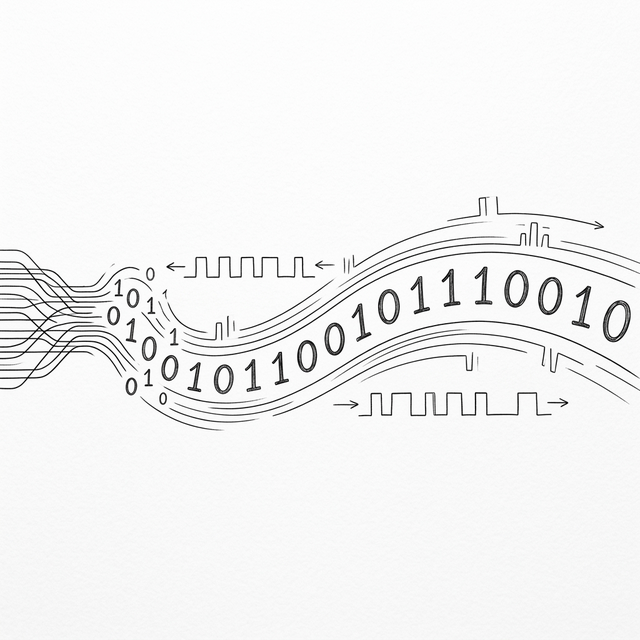
Newcomers to audio production often confuse MIDI with digital audio. While both can be played by a computer, they are as different as a printed book and a video of someone reading that book. One is a set of instructions; the other is a literal recording of air pressure. Understanding this distinction is key to knowing which tools you need for your project. Let's look at the parallel worlds of MIDI and PCM.
MIDI: The Digital Sheet Music
MIDI (Musical Instrument Digital Interface) contains no sound whatsoever. It is a language of binary instructions: "Play Middle C," "Play it with a velocity of 100," "Hold it for 2 seconds." When you play a MIDI file, your computer’s "Synthesizer" reads these instructions and generates sound on the fly. This makes MIDI files incredibly tiny—you can fit a 10-minute symphony into a 50KB file. The downside? It sounds different on every device because it relies on the local sound bank.
PCM: The Literal Capture
Digital audio (PCM, WAV, MP3) is a record of a sound wave. It doesn't care *what* made the sound—it just records the result. This makes digital audio files much larger, but it guarantees that the sound will be exactly the same every time it's played. Our platform focuses on this "Digital Audio" side of the world. We help you manage those large PCM and WAV files, ensuring that the nuances of your recording are preserved, regardless of what instrument was originally played.
The Bridge: Sampling
The two worlds meet in "Sampling." This is where a computer takes a literal PCM recording of an instrument (like a real Steinway piano) and uses it as the sound source for MIDI instructions. This is how modern film scores are made—composers play MIDI keyboards that trigger gigabytes of high-quality PCM samples stored on their hard drives. When you use our tool to convert a high-res sample library into a more compact format, you are working at the very intersection of these two technologies.
Conclusion
Know which world you are in. Use MIDI when you need to edit the notes, change the tempo, or keep file sizes microscopic. Use Digital Audio (PCM/WAV) when you need to capture a performance, a voice, or a unique environmental sound. By mastering both, you become a complete digital architect.
Thanks for reading our technical deep-dive!